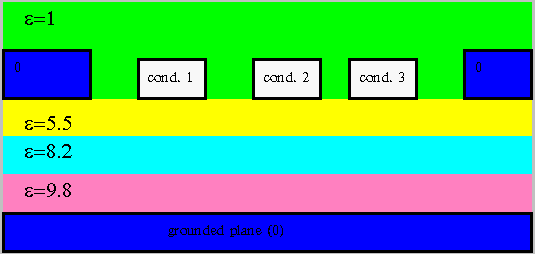
The program LCR2D has been developed as general, fast and reliable tool for the extraction of matrices of self and mutual capacitance C, inductance L, conductance and resistance G and R by use of the 2D approach. The program can be implemented for:
The program LCR2D is fast and precious. It can be used in CAD applications for the extraction of the models parameters. Probably, in many cases our program can be fast enough for direct calculations as the subroutine in the process of circuit optimisation.
All problems the program LCR2D can solve in general can be reduced to the problem of extraction of the matrix of the capacitances of a multi-conductor transmission line buried in non-homogenous media. This problem was of very high interest in microelectronic and other areas. The considerable attention was paid during last decades for the development of the computer programs for this problem (see the manual).
Most of the works concerned the capacitance extraction are based on the nearly similar technique, "Moment Method" or indirect Boundary Element Method (BEM). The other works use finite element method (FEM) or other technique closed to BEM or FEM. By many reasons BEM is more preferable and leads to more general and effective programs.
Nevertheless, the conventional version of method of moments (BEM) is not effective enough and can result in long and not accurate enough calculations. The reason is in the significant influence of corner points, proximity effects, different boundary conditions interfaces and poor convergence of the moments method. As the result, the program realization of the conventional method of moments does not realize all the advantages of the boundary element technique.
The program LCR2D is also based on indirect boundary element method. This program exploit another general scheme of BEM which is different from the conventional method of moments and is more adequate the problem. Another improvement in the numerical technique is the effective mesh grading approach with some enhancements.
As result, LCR2D realize the second order of convergence from respect to the mesh cell density parameter . For conventional moments method the first or worse order of convergence is natural.
The other improvement is the iteration solver GMRES, included in the program. Due to it and disk memory usage even very large problems can be solved on the ordinary old PC.
The improvements in the numerical technique represented in LCR2D results in the speed and accuracy of calculations as well as in the generality of the program.
The features of the program LCR2D are:
The approach of LCR2D was extended on the axially symmetrical problems. It was successfully applied for the problem of precious calculation of magnetic lenses.
Command line version of the program recently was rewritten using GNU G77 Fortran. The graphic control output is PostScript. This console version can be ported to UNIX.
One version of LCR2D is written for WINDOWS NT (95) with some graphics.
There are some minor changes in input compare with old versions. Some unnecessary parameters (TMP DIR) are hidden. To avoid error message delete old file DEM1.DAT.
Click here to get the student version.