We consider the problems for stationary distribution of the density of superconductive current in microelectronic devices. The special interest for the development of such devices presents the problem of extraction of the matrix of self and mutual inductances. The thickness and linear sizes of modern devices are rather small and it is necessary to take into account the London effects of finite penetration depth of current distribution. For single-layer planar circuits the magnetic field has essentially 3D structure. This circumstance practically exclude the application of simplified 2D models of a transmission line type. Nevertheless the problems of design and simulation on the level of equivalent circuits needs precious, reliable, valid and easy to use tools for inductances extraction.
In our work we use the complete and correct setting of the problem for superconductive current density evaluation and the extraction of the inductances matrix of planar circuits. The single layer circuit can be of arbitrary shape with arbitrary number of internal holes and current terminals. The ground plane effects are included so the program can be applied to the structures with single or two layers of the metallization. The problem setting is based on the London model of superconductive current, the smallness of the thickness of superconductor and certain potential representation (stream function, T-function) for sheet current density. The matrix of self and mutual inductances is introduced by use of the functional of full energy. It is shown that by use of the inductance matrix the fluxoids in the holes in superconductor can be calculated. It is shown that by use of the inductance matrix for terminal currents is possible to introduce the values related to fluxoids in holes. These values can be used for the extraction of the parameters of equivalent circuits.
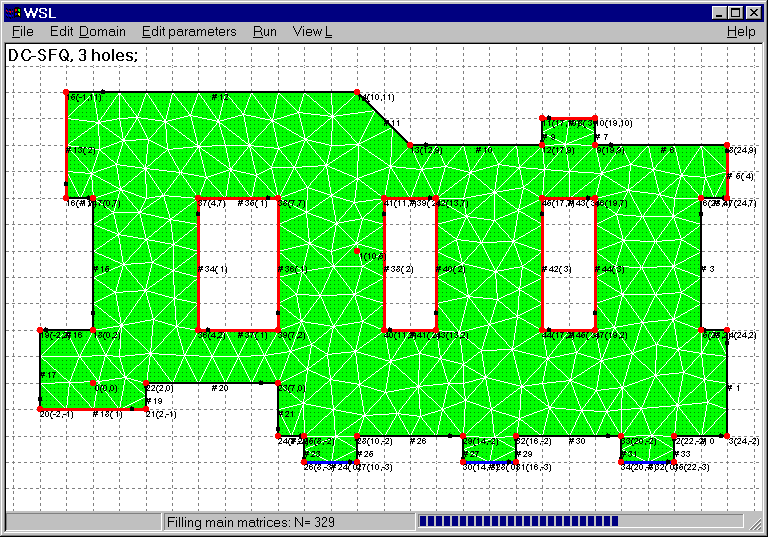
The numerical technique of the present work is based on the triangulation of the part of the plane occupied by the superconductor and the finite element method. The finite elements approximation is linear. In this case the density of current is simulated by circulating currents with piecewise-constant density. The numerical approach is proved and leads to the system of linear equations with symmetric positively definite dense matrix. The inductance matrix is calculated by use of sequence of problems for current density. The program contain triangular mesh generator based on one of the modern and most effective techniques. The mesh generator contain the tools for mesh refinement.
The time of calculations in our approach weakly depends of the dimension of the inductance matrix (the number of holes plus the number of terminals) and depends mainly of the number of the internal nodes of the finite element mesh.
The program, WSL, is written on C++ for WINDOWS NT 4.0 and WINDOWS 95. The program has user-friendly interface.
Click here for demo version with theory survey and manual.
Some results of inductances calculations with ground plane and with ML (related program) are presented in SDE CAD tools, Inductance Rodeo Results. The results presented there for ground plane mirror reflection method are identical for WSL.
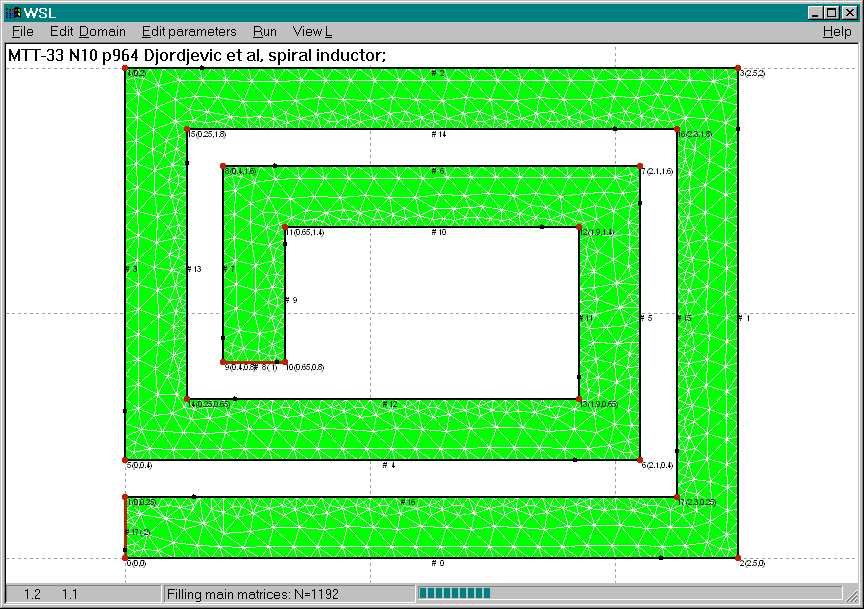
Another application of WSL is calculation of inductances of normal conductors. Here is spiral inductor from IEEE Trans. on Microwave theory and Techn., vol. 38, N10, October 1990, pp. 1407-1414: